
Acorn Aluminium’s work at Tariff Street in Manchester, in a constrained city centre location, demonstrates how planning, factory capacity, phased delivery and close coordination between pre-construction and site teams are essential for projects of this kind.
Located prominently in Manchester city centre, the Tariff Street high-rise residential development is a big construction project with little room for manoeuvre.
With minimal space available for material storage during the build, restricted access and strict installation schedules posed additional challenges for all involved.
“The Tariff Street project is situated in quite a tight spot, which sort of fills the footprint, so our on-site storage capacity was limited,” explains Craig Key, Operations Director at Acorn Aluminium.
In response, Acorn placed strong emphasis on planning and logistics in its delivery of the energy-efficient glazing for the project, taking a phased approach.
Using products including Kawneer’s AA100 curtain walling, AA720 windows, and AA190TB thermally broken door systems, as well as Sotek rainscreen cladding, Acorn coordinated multiple façade elements for a single residential scheme.
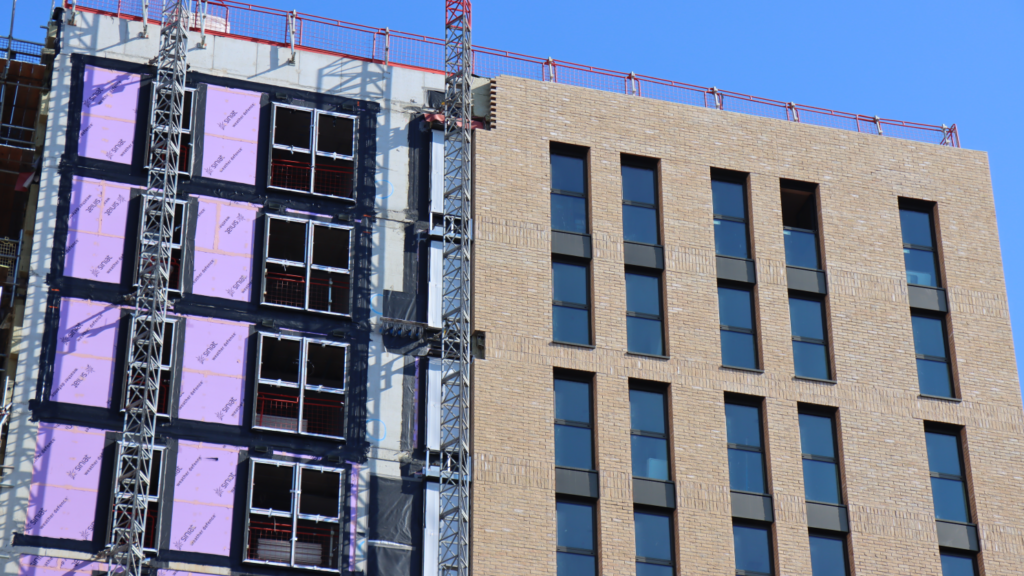
Operating from a 33,000ft2 manufacturing facility, Acorn was able to make the required products and keep them on its premises until needed, to avoid clogging the site.
“Having a 33,000 sq ft factory provides lots of warehousing space, which means we can manufacture ahead, store the products and then deliver them, just in time, to site,” explains Craig.
This delivery model helps to reduce congestion, eliminate double handling and ensure valuable site space remains available for construction works, rather than storage.
At Tariff Street, Acorn’s teams collaborated to coordinate deliveries and ensure that all associated items arrived together when required.
“Our pre-construction team work closely with the site team to ensure we procure and deliver everything at the same time, from frames to fixings to EPDM,” explains Craig.
“This ensures that when we deliver a phase, it’s packaged as a phase, and the site team can complete the install with all the required items.”
With performance a key consideration, as demand for high-quality residential developments grows, triple glazing was specified on some elevations to support thermal efficiency and acoustic requirements, enhancing occupant comfort in a busy city-centre environment.
“Residential developments need to deliver in terms of reducing bills for occupants but also increasing their wellbeing,” added Craig. “The glazing specification plays an important role in achieving that, particularly in locations where things like external noise can be a challenge.”

With logistics and planning an essential aspect of façade delivery on sites with access constraints, early coordination between design, manufacturing and site teams, combined with phased delivery, helps reduce the risk of delays caused by missing materials, storage limitations or sequencing issues.
By combining manufacturing capacity with detailed pre-construction planning, Acorn Aluminium enables main contractors to manage risk more effectively and maintain installation efficiency, even on the tightest city-centre sites.
“It’s about ensuring that products arrive on site in the right order, at the right time and with everything needed for installation. That’s what gives contractors confidence – and at Acorn, that’s what we can deliver,” adds Craig.
For more about Acorn Aluminium, please call 0115 928 2166, email [email protected], or visit www.acornaluminium.com.